Defining Our Identity: The Declaration of Independence and the Core Liberal Values of Jewish Heritage.

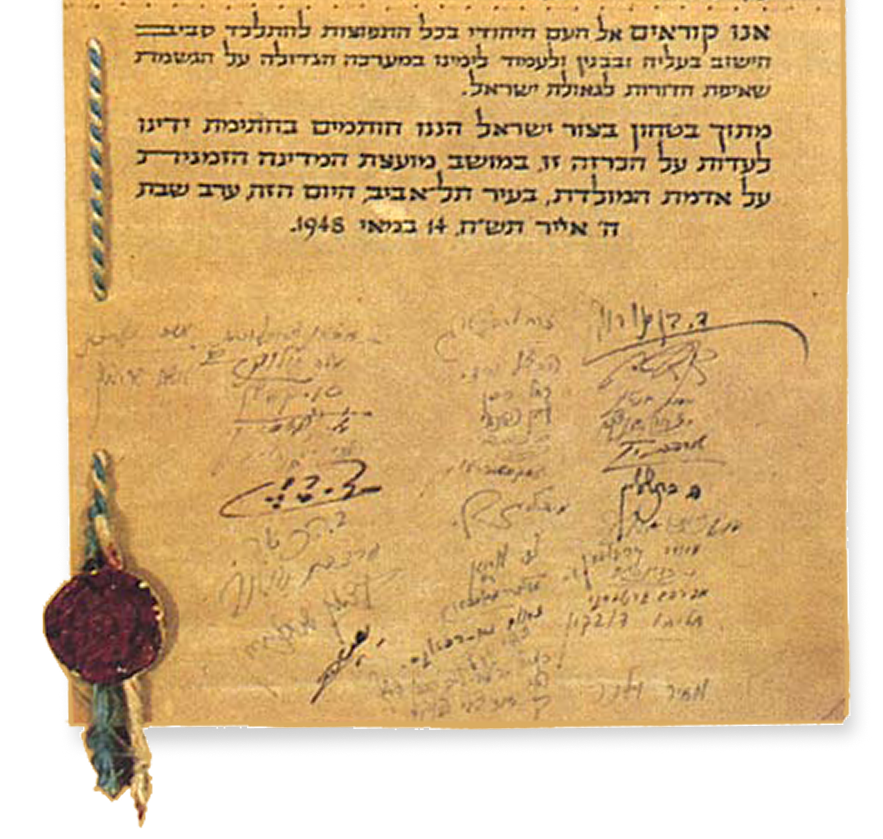
The Declaration of Independence is the most important Jewish principles document in the modern era. It is a document describing the path the Jewish people have traveled from the Book of Books (The Hebrew Bible) to the modern sovereignty of Israel. But it is not only a description; it is an answer to the question, "Who are we?" We are modern Jews, bearing a legacy and culture – meaning a multiplicity of forms of life, affiliation, and contemporary creation. We are the successors of the "pioneers who bring souls to bloom" (a pioneering spirit).
We carry the torches of illuminating values since the vision of the prophets – liberty, justice, equality, peace, education, and culture. All of these evolve and take on a new form in every generation since Isaiah declared, "Learn to do good; seek justice." Belief in humanity begins with learning. Reason is what distinguishes us from animals, and in its light, we have the freedom to ask, to be enlightened, and to choose. This applies to us – to human beings. Every person holds equal inherent value and potential.
"All human beings are born free and equal in dignity and rights. They are endowed with reason and conscience..." declares Article 1 of the "Universal Declaration of Human Rights," which was written concurrently with Israel's Declaration of Independence, led by a Jew named René Cassin, and signed in December 1948. This represents one of the peaks of human consensus – for the benefit of humanity.

From liberty and equality, injustice among people must not be allowed. This is "the way of the Lord, to do righteousness and justice" that Abraham commanded all his descendants. "All are equal before the law," states the UN Declaration, fully in the spirit of Leviticus: "You shall have one manner of law."
Our "natural right," declared in the Declaration of Independence – meaning the right to sovereignty for every nation – complements the fundamental human right to freedom, because liberty and education do not exist in a vacuum, but within the language and culture of a community. A person is never a solitary animal.
Our Declaration takes pride in our stand alongside "the liberty- and peace-loving nations" against the Nazis, because the "free world" is not guaranteed to anyone. The struggle begins in consciousness: "Disregard and contempt for human rights have resulted in barbarous acts" (The Preamble to the Universal Declaration of Human Rights).
Where does the line of "disregard" fall? Naturally, the intent is the practical abuse of a person, but there are signs or preconditions for this that we must identify and invest in – in our language, in education, and in our attitude toward bodies and individuals.
Belief in humanity is walking on a tightrope. We look forward with the hope that there is some ultimate truth we are striving toward, but at the same time, we assume that we are, after all, sensitive and temporary beings – prone to error.
Two sides of an abyss lie in wait for us:
If we abandon hope in truth, we will plunge into the abyss of relativism where all truths are equal, or are not counted because there is no way to judge anything. This path leads to loss of meaning, depression, and the justification of power as an end in itself – in a jungle morality.
If we abandon the skeptical assumption that we are prone to error—that is, if we adopt dogmatic approaches that have already discovered the complete truth—we will trample our freedom and become enslaved to the delusions of dogma.
Dogmatic ideologies – Fascist or Communist – are not essentially different in this regard from any religious dogmatism. They deviate from the secular ideal that connected reason to liberty and to the "peace of the State," as Spinoza described. Whoever gives up the ideal of belief in humanity, on the solitary person's capacity for navigation, allows some delusion to seize control of the complexity of life – ultimately, they will harm humanity.
The tightrope of belief in humanity is not that weak, but it nonetheless suffers from an inherent dependency: on education and peace. States of war and the absence of education return us to the jungle. Conversely, conditions of peace and education allow us to increase cooperation, thanks to which we have reached the best period of human prosperity ever.
The great leap in prosperity occurred after the Enlightenment movement offered the world a new option – education for all. "Dare to Know" called Immanuel Kant – along with Moses Mendelssohn, Solomon Maimon, and many other Jews.
Anyone who dismisses the Enlightenment casually is suggesting we dismiss humanity and its critical capacity. It is our duty to invest in education, asking questions, and nurturing the values of the Declaration of Independence – so that we do not abandon the social order to a king, or a coercive elite. Every ideology, religious or otherwise, must be tested against these simple values.
Resolutely, we must push back and prevent enclaves of ignorance, racism, and nationalism that turn their backs on the belief in humanity.
The ability to succeed in this struggle is connected to our internal strength. Therefore, it is essential to remember and cultivate the knowledge that we possess not only the good outcomes of enlightened democracies, but the recognition that these are the values of our heritage!
The values that enable prosperity and peace for every person are for us part of the ancient legacy of the People of the Book.
The 'Judaism of the Declaration of Independence' is the basis for the unity of the people of Israel and will guarantee Israel's future.
Therefore, we are in a struggle for our Judaism! ...
Dr. Oren Yehi-Shalom, co-founder of the public initiative "We Are the Judaism of the Declaration of Independence," is an author and lecturer specializing in Judaism as culture.


